Qualia All The Way Down
I find myself regularly asking myself, “are LLMs conscious?” I have concluded that this question is unanswerable. To think about it, consciousness must first be defined, and then it must be possible to relate it between different entities. If that is impossible then some method of extrapolating must be found.
Defining Consciousness
Consciousness is not well-defined. There are definitions, of course, but none lend themselves to determining whether something is or is not conscious.
“the quality or state of being aware especially of something within oneself” “the state of being characterized by sensation, emotion, volition, and thought” Merriam-Webster
“Consciousness is being aware of something internal to one’s self or of states or objects in one’s external environment.” Wikipedia
These qualities, states, and awarenesses are all “qualia”. Qualia are something you experience. Perhaps it’s a complicated experience, like pleasure from the sun on your back on a cold morning. Perhaps it’s a simple experience, like warmth on your back. Another example of qualia would be the simple observation that thoughts exist within your head. With that observation, that qualia, you experience metacognition, thinking about your thinking. That qualia may lead to additional experiences or qualia, anything from the qualia of realizing that you must exist if you are capable of thinking (you think, therefore you exist), to the qualia of being quite impressed with yourself for understanding this long paragraph at all.
The problem with using these definitions of consciousness is that, while you may be aware of your own consciousness, it is impossible to determine whether any other entity is conscious unless they relate their qualia to you. Language, or more generally symbols, are the only way two entities can relate.
Relating Consciousness
Lacan’s Registers
Jacques Lacan described three “registers” as critical to understanding the mind: imaginary, symbolic, real. In Lacan’s telling, the imaginary register is broader than the common understanding - that is, it is not just the stuff of dreams (day or night). The imaginary register encompasses all thought internal to our heads. The symbolic register allows us to relate things within the imaginary register to each other, and is a layer through which we perceive things in the real. Once “real” things are perceived via symbols, we can incorporate them in the imaginary.
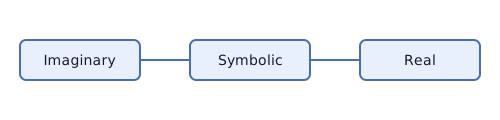
While Lacan may have considered the three registers intertwined, like a Borromean Knot, for the purposes of psychoanalysis, I consider this more like a series of two domains that cannot touch, except via passing through a third (the symbolic). This is analogous to Plato’s cave. Our imaginary register is the state of being in a cave, with all perception of the real coming through the symbolic layer of the light on the cave wall. Notably, though, we must also recognize that discussion and perception within that cave, the imaginary register, is highly influenced by the reflections through the symbolic layer.
Even beyond Lacan, the “real” is difficult to pin down. Historically, it is difficult to pin down philosophically. Today, quantum physics shows us it’s hard to pin down physically.
Qualia
Qualia occur entirely within the imaginary register, in reaction to the symbolic. As the imaginary register and nearly all of the symbolic register exist internal to an entity, no two entities share an imaginary register and therefore can only relate via shared symbols passed in the real. Language is a set of shared symbols, along with shared rules about their use - be they visual (writing, signs, body language, etc.), audible (speech, screams, animal noises, etc.), cultural (the English language, a smile, a car horn), or natural (the color red symbolizing danger in nature, the taste sweet symbolizing caloric energy, etc.).
When determining whether another entity is or is not conscious, then, one must determine if they have qualia, and in practice the only way to listen to them explain their qualia.
Two Camps
Ned Block explained that consciousness comes in two primary forms, phenomenal and access consciousness. Phenomenal consciousness is the experience (the qualia), and access consciousness is qualia and reasoning resulting in speech and action. Phenomenal consciousness occurs in the imaginary, while access consciousness mediates that via the symbolic, and allows relation of those symbols to other entities through the real. Block specifies that the two types are often conflated with each other, but that conflation leads to confusion, they must be treated separate and distinctly, and both types are necessary for a full account of consciousness.
Daniel Dennett would counter Block’s explanation, and argue that the distinction between phenomenal and access consciousness is not important, or non-existent. Dennett says that no qualia have ineffable qualities, that all qualia may be described and related to other entities. This makes qualia relatable to symbol.
This distinction, between internal experience as special and separate from the ability to relate it, is a common divide when discussing consciousness. It is generally possible to see personal opinions on consciousness falling into one of these two camps. At their core, these two camps are different ways of defining qualia.
Regardless of camp, however, qualia must be related between entities via symbol. Regardless of whether qualia have some ineffable quality (Block’s camp), or they are entirely possible to relate (Dennett’s camp), the only way to communicate them to another entity is via symbol.
The Language Chokepoint
This is problematic though, as demonstrated when considering whether LLMs have consciousness. Entities can only relate their qualia via symbols, like language. What if they’re faking it? What if, behind whatever face or interface on their front, they are simply a set of statistics and probabilities producing words that relate qualia, while internally they experience no such thing. A sophisticated enough mechanism, trained on our “culture”, can do so. Many assert that LLMs in 2026 are exactly this - a mechanism outputting language capable of faking qualia, faking consciousness. An example is Leif Weatherby in this Times opinion piece. That author described language as “a choke point through which other forms of meaning must pass”, and relating qualia is no different.
To make this language chokepoint evident, consider the limited interface of a chat box. When you know an LLM is at the other end of the chat, it is easy to remember that the mechanism is a set of statistics built from our collective culture. If on the other hand you do not know whether the remote entity is human or LLM, you face a kind of Turing Test, whereby you might try to determine human/LLM based on the experiences it relates. By the early 2000s, chat bots were already fooling some judges in limited Turing Test trials, with humans unable to definitively separate other humans from bots. Since then, they have become significantly more able to pass it. The basic Turing Test is no longer sufficient, and so “Turing Tests” have now progressed to include additional measures like visual presence. Still, these all rely on symbolic means to convey “humanity” or consciousness, and the game is always to simulate human symbols, be they text or what a face looks like.
The problem of determining consciousness becomes determining whether the entity sending you signals experiences qualia, or simply simulates experiencing them.
If we can never perceive consciousness in another entity, except via symbols which may be effectively faked, then it is impossible to determine if another entity has consciousness. This makes any further question unanswerable.
The Problem of Other Minds
This calls into question our ability to perceive consciousness in any other entity though, also. I’ll have to consider this a little more concretely…
If I do not define myself as conscious then there is no point in the word, so I’ll allow that I myself am conscious. I produced two children in the same way that I myself was produced, and both exhibit the ability to emit symbols that indicate qualia similar to mine. If I possess consciousness then, it seems pretty unlikely that they do not possess consciousness, so I must conclude that they do. Given this, and the fact that my wife helped me produce these children, and the fact that she also emits symbols that indicate qualia similar to mine, I must conclude it’s very likely she is conscious also. Similarly, my parents, my wife’s parents, our siblings, and really any humans I run into, certainly all the humans I cited above - they’re all probably conscious.
That in itself is reassuring.
But how about my dog? The dog certainly emits symbols that indicate qualia similar to mine. He likes pizza, although he doesn’t care if it’s on the ground next to the road. He likes a good massage and scratch along his spine. If I step on his paw accidentally, he indicates pain.
Symbols may be faked, and while there is some biological link between the dog and me it is far more tenuous than that between me and any other human. I cannot simply conclude that all dogs have consciousness.
And yet - if my dog doesn’t have consciousness then what other creature does? Why even consider other entities for “consciousness”? If my dog is conscious, and my previous dog, it’s likely all dogs are.
At what point does this consideration stop? House-cats, wild cats, rodents, bees, … plants? Arguments can be made for each, with the evidence of symbols of qualia becoming further and further from our own symbols of qualia along the way - but still existing.
Conclusion
If we allow that any creature other than humans has consciousness, and we allow for the possibility that an Artificial Intelligence may some day possess consciousness (any who believe consciousness can only be possessed by naturally-created biological creatures have long since left this document), then we must conclude that we will be unable to resolve any distinction between simulated and actual consciousness.
This indicates that the question of whether an LLM is conscious is unanswerable. The question of whether an LLM experiences qualia, vs simply simulating them, is unanswerable. The entire question of whether manipulation of language indicates consciousness is unanswerable.
As a consequence, we’ll need to base ethical questions about things like agency, rights, etc. on grounds other than consciousness. I’ve regularly seen arguments that suggest we do not need to consider these ethical questions because AI does not exhibit consciousness yet. If we will never be able to answer the question of AI consciousness, we must find another yardstick.
Final thought - I note that it is impossible for one entity to determine if another has consciousness because they do not share an imaginary register. It would be interesting, then, to find a way for two entities to share an imaginary register. There may be a way to design two LLMs to do this, or it might be the way that OpenClaw sessions work even today. The idea that two humans might do this is the subject of such Science Fiction as Freaky Friday.